

Date: November 9, 2026 | 7:00 PM CST/8:00 PM EST
Duration: 1 Hour
Credits: 1
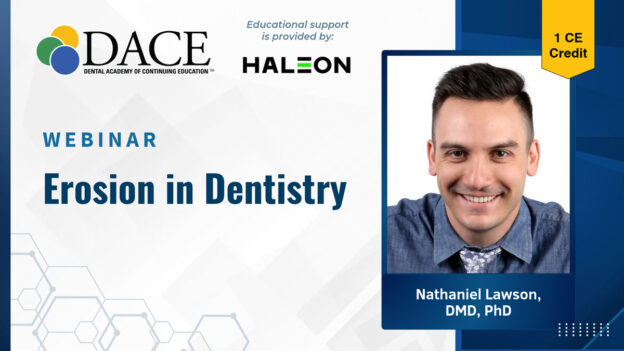
Presenter: Nathaniel Lawson DMD PhD
Sponsor: Haleon
Cost: Free
Dental erosion is the chemical dissolution of tooth structure by acids that bacteria did not produce. It is increasingly common in middle-aged and older adults. This course explains how erosion differs from caries in where it appears and how it develops. It shows why a beverage’s buffering capacity can predict how erosive it is better than its pH can. It reviews the dietary and intrinsic causes of erosion, including gastroesophageal reflux disease (GERD) and frequent vomiting. Evidence-based management is covered: chairside saliva testing, agents that raise oral pH, stannous fluoride dentifrices, and practical counseling on diet and toothbrushing.
Learning Objectives
After completing this course, participants should be able to:
- Tell erosive demineralization apart from caries-related demineralization based on where the lesions are and how they look.
- Explain why buffering capacity predicts a beverage’s or mouthrinse’s erosive potential better than its pH does.
- Identify the dietary and intrinsic (gastric) sources of acid that cause erosion, and describe the medical and lifestyle measures for managing reflux.
- Interpret a chairside saliva buffering test, and describe how bicarbonate, arginine and stannous fluoride each protect against erosion.
Presented By

Nathaniel Lawson DMD PhD is the Director of the Division of Biomaterials at the University of Alabama at Birmingham School of Dentistry and the program director of the Biomaterials residency program. He graduated from UAB School of Dentistry in 2011 and obtained his PhD in Biomedical Engineering in 2012. His research interests are the mechanical, optical, and biologic properties of dental materials and clinical evaluation of new dental materials. He has published over 200 peer reviewed articles, book chapters, and research abstracts. He was the 2016 recipient of the Stanford New Investigator Award and the 2017 Innovative Research Fellowship both from the American Dental Association. He served on the American Dental Association Council of Scientific Affairs and is on the editorial board of The Journal of Adhesive Dentistry and Compendium. He has lectured nationally and internationally on the subject of dental materials. He also works as a general dentist in the UAB Faculty Practice.
Supported in part through an unrestricted educational grant by:

Course Content
Course Includes
- 1 Lesson
- Course Certificate
CE credit(s): 1
Course Type: Live Webinar
Published Date: November 9, 2026
This continuing education (CE) activity was developed by Endeavor Business Media with no commercial support.
This course was written for dentists, dental hygienists, and dental assistants, from novice to skilled.
Educational methods: This course is a self-instructional journal and web activity.
Provider disclosure: Endeavor Business Media neither has a leadership position nor a commercial interest in any products or services discussed or shared in this educational activity. No manufacturer or third party had any input in the development of the course content.
Requirements for successful completion: To obtain 1 CE credits for this educational activity, you must pay the required fee, review the material, complete the course evaluation, and obtain an exam score of 70% or higher.
CE planner disclosure: Laura Winfield, Endeavor Business Media dental group CE coordinator, neither has a leadership nor commercial interest with the products or services discussed in this educational activity. Ms. Winfield can be reached at lwinfield@endeavorb2b.com.
Educational disclaimer: Completing a single continuing education course does not provide enough information to result in the participant being an expert in the field related to the course topic. It is a combination of many educational courses and clinical experience that allows the participant to develop skills and expertise.
Image authenticity statement: The images in this educational activity have not been altered.
Scientific integrity statement: Information shared in this CE course is developed from clinical research and represents the most current information available from evidence-based dentistry.
Known benefits and limitations of the data: The information presented in this educational activity is derived from the data and information contained in the reference section.
Registration: The cost of this CE course is Free for 1 CE credits.
Cancellation and refund policy: Any participant who is not 100% satisfied with this course can request a full refund by contacting Endeavor Business Media in writing.
Provider information:
Endeavor Business Media is a nationally approved PACE program provider for FAGD/MAGD credit.
Approval does not imply acceptance by any regulatory authority or AGD endorsement.
11/1/2024 to 10/31/2028.
Provider ID# 320452
AGD code: 010
Endeavor Business Media is designated as an approved provider by the American Academy of Dental Hygiene, Inc. #AADHEBM (January 1, 2025 - December 31, 2026). Approval does not imply acceptance by a state or provincial Board of Dentistry. Licensee should maintain this document in the event of an audit. AADH code: AADHEBM-691-11-2026-1